
EDUCATION
Udemy Legit Guide: Certificates, Reviews, and Value


If you’ve searched for affordable online courses, chances are you’ve come across Udemy. With thousands of courses across tech, business, design, and personal development, it’s one of the biggest names in e-learning. But many learners still wonder: Is Udemy legit?
This guide gives you a transparent, expert-backed breakdown of Udemy’s legitimacy, certificate value, course quality, and how it compares to other platforms. Whether you’re a student, professional, freelancer, or lifelong learner, this article will help you decide if Udemy is worth your time and money.
What Is Udemy?
Udemy is a global online learning platform founded in 2010. It hosts 200,000+ courses created by independent instructors. Unlike Coursera or edX, Udemy does not partner with universities but allows industry experts to upload and sell their own courses.
- Accessible: Affordable prices and frequent discounts.
- Flexible: Learn at your own pace with lifetime access.
- Diverse: Covers everything from coding and marketing to yoga and cooking.
Is Udemy Legit or a Scam?
The short answer: Yes, Udemy is legit.
Udemy is a registered company with over 64 million students worldwide and a strong reputation in the e-learning industry. Its courses are widely used by individuals, startups, and even Fortune 500 companies.
Why Udemy is Legit:
- Millions of verified student reviews
- Secure payment and refund policy
- Partnerships with businesses for workforce training
- Recognized by trusted media like Forbes and TechCrunch
Reference: Forbes has consistently listed Udemy as one of the leading online learning platforms in 2023–2024.
Udemy Course Reviews: Are They Worth It?
Udemy course reviews vary depending on the instructor. Because anyone can upload a course, quality is not uniform.
- Highly rated courses often come from industry experts with proven experience.
- Some cheaper or newer courses may lack depth.
Pro tip: Always check course reviews, ratings, and previews before buying.
Udemy Certificate Value: Do Employers Recognize It?
One of the most common concerns is: Are Udemy certificates recognized by employers?
- Value for Skill-Building: Certificates show initiative and continuous learning.
- Limitations: Udemy is not an accredited university. Certificates are not equivalent to degrees or diplomas.
- Practical Use: Great for showcasing on LinkedIn, freelance profiles, or job applications where practical skills matter more than formal accreditation.
Udemy Accreditation Status
Udemy is not an accredited institution. This means certificates do not carry the same weight as those from Coursera, edX, or university programs. However, many employers value the skills gained, especially in IT, business, and digital marketing.
Udemy vs Coursera: Legitimacy Comparison
| Feature | Udemy | Coursera |
|---|---|---|
| Accreditation | Not accredited | Accredited (with universities) |
| Pricing | Affordable, one-time fee | Subscription or pay-per-course |
| Course Instructors | Independent creators | Professors + experts |
| Certificates | Non-accredited | University-recognized |
| Flexibility | Lifetime access | Time-bound courses |
If you want accredited certificates, Coursera is stronger. If you want affordable skills-on-demand, Udemy is legit and practical.
Udemy Refund Policy Reviews
Another sign of legitimacy is a clear refund policy. Udemy offers a 30-day money-back guarantee, making it low-risk for new learners.
Best Udemy Courses (Legit and Popular in 2025)
Some courses consistently earn excellent reviews and credibility:
- The Web Developer Bootcamp 2025 – Colt Steele
- Microsoft Excel – Excel from Beginner to Advanced
- Digital Marketing Masterclass – Phil Ebiner
- The Complete Python Bootcamp – Jose Portilla
Is Udemy Legit for Professional Development?
Yes — if you choose courses wisely. Professionals use Udemy to:
- Upskill quickly without expensive tuition
- Gain tech skills like Python, JavaScript, or AWS
- Improve soft skills like communication and leadership
- Reference: A 2024 LinkedIn Workplace Learning Report noted that employers increasingly value non-traditional skill development platforms like Udemy for Business.
How Trustworthy Is Udemy as a Learning Platform?
Udemy has built trust through:
- Transparent reviews
- Secure payments
- Global instructor community
- Millions of success stories
FAQ’s
Is Udemy legit for learning new skills?
Yes, it’s a trusted platform used by millions worldwide.
Are Udemy certificates recognized by employers?
They’re not accredited but show initiative and practical skills.
Can I get a job with a Udemy certificate?
Alone, probably not — but combined with skills and experience, yes.
How does Udemy compare to Coursera or LinkedIn Learning?
Coursera offers accredited certificates; Udemy is cheaper and more flexible.
Are cheap courses on Udemy actually legit?
Yes, though quality varies. Always check reviews before enrolling.
Is Udemy worth it in 2025 for career growth?
Absolutely, especially for skill-based industries like IT, design, and marketing.
Can Udemy replace formal education?
No — but it’s an excellent supplement for practical, hands-on skills.
Conclusion
So, is Udemy legit? The answer is a confident yes — but with context. Udemy is a trustworthy, affordable platform for learning real-world skills, though it doesn’t replace accredited education. For students, professionals, and lifelong learners, Udemy is a valuable resource when courses are chosen carefully.
If your goal is practical skills and career growth at a fraction of the cost, Udemy is one of the most legit platforms available in 2025.


How many grams in a quarter pound, we need to understand the basics of units of measurement. A quarter pound is a unit of weight commonly used in the United States, while grams are a unit of weight in the metric system.
The Metric System
The metric system is a decimal-based system that is widely used around the world. It’s based on the gram, which is a unit of weight that is defined as one thousandth of a kilogram.
Converting Quarter Pounds to Grams
To convert a quarter pound to grams, we need to know that 1 pound is equal to 453.592 grams. Therefore, a quarter pound is equal to 113.398 grams.

Practical Applications
Understanding how to convert between units of measurement is crucial in various fields, including cooking, science, and commerce. For instance, if you’re a recipe developer, you may need to convert ingredients from one unit to another to ensure accuracy.
One user reported, “I was trying to follow a recipe that used metric measurements, but I only had a scale that measured in pounds. I was able to convert the ingredients using an online converter, and it worked perfectly!”
Frequently Asked Questions
Q: How many grams are in a quarter pound?
A: A quarter pound is equal to 113.398 grams.
Q: How do I convert pounds to grams?
A: To convert pounds to grams, you can multiply the number of pounds by 453.592.
Q: What is the difference between a quarter pound and 100 grams?
A: A quarter pound is approximately 113.398 grams, which is more than 100 grams.
Q: Can I use an online converter to convert quarter pounds to grams?
A: Yes, there are many online converters available that can help you convert quarter pounds to grams quickly and accurately.
Conclusion
Units of measurement, you’ll discover the importance of understanding how to convert between different units. Whether you’re a professional or simply someone who loves to cook, being able to convert quarter pounds to grams is a valuable skill.

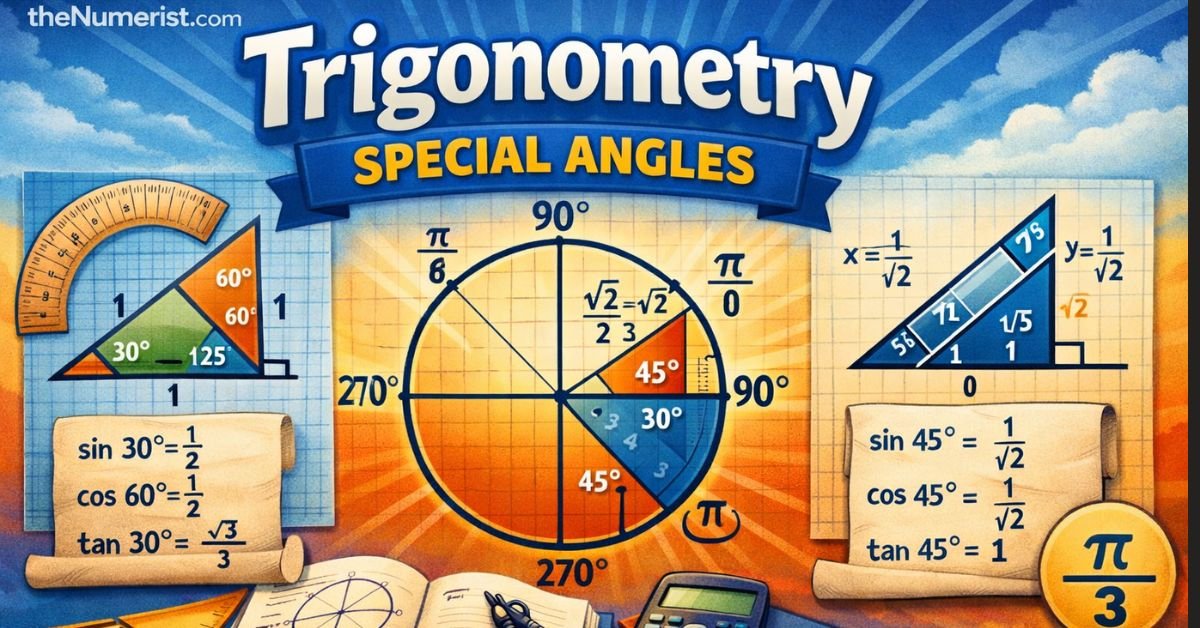
Trigonometry is the type of math that you use when you want to work with angles. Luckily, some angles are used so frequently that they have their own dedicated name and shortcuts that you can memorize. These are called special angles in trigonometry, and you can use special angle triangles to help.
Special angles are great to know because their trigonometric functions equate to very specific and known ratios, so if you can memorize these it will save you a lot of time in doing trigonometry homework! To make things a bit easier, if you can’t remember these exact values, it is even easier to memorize the special angle triangles that these angles are based off of! And there are only two triangles, so you will find that it is very easy to derive the trig functions if you can’t remember them.
Specifically, the trig functions are easy to find for these special angles, which are: 0, 30, 45, 60, and 90 degrees.
45-45-90 Triangle
This will hopefully make sense after looking at the triangles I mentioned. Here’s another site that also talks about remembering the patterns of these triangles instead of specifically remembering the math. Create a right angle triangle with two 45 degree angles, and with two sides of 1 unit length. By using the Theorem of Pythagoras, you can find that the hypotenuse of this triangle is easy to calculate to be length √2. This is what this triangle looks like:
So then, from these values and using the memorization trick of SOHCAHTOA (here a quick trig cheat sheet for reference), you can obtain the trigonometric values for this special angle of 45 degrees. You can work out that:
Sin(45) = 1/√2
Cos(45) = 1/√2
Tan(45) = 1
Don’t worry if you can’t remember these values and ratios. The easiest way to remember them is to memorize how to construct the special angle triangle. And as you can see, this triangle is very simple: a right angle triangle with a 45 degree angle and 2 sides of length 1, and you can easily fill in the rest and then work out the ratios yourself.
30-60-90 Triangle
The second of the special angle triangles, which describes the remainder of the special angles, is slightly more complex, but not by much. Create a right angle triangle with angles of 30, 60, and 90 degrees. The lengths of the sides of this triangle are 1, 2, √3 (with 2 being the longest side, the hypotenuse. Make sure you don’t put the √3 as the hypotenuse!). FreeMathHelp also has a good explanation of this particular triangle. This triangle looks like this:
Here are the trig ratios that you can easily find:
Sin(30) = 1/2
Cos(30) = √3/2
Tan(30) = 1/√3
Sin(60) = √3/2
Cos(60) = 1/2
Tan(60) = √3/1 = √3
Once again, just remember the triangle, and the ratios are easy to derive!
For 0 and 90 degrees, there isn’t a triangle to remember (although please feel free to correct me if I am wrong!), so you will actually have to memorize these values. However, these aren’t complex. I usually just remember the pattern of the following list:
Sin(0) = 0
Cos(0) = 1
Tan(0) = 0
Sin(90) = 1
Cos(90) = 0
Tan(90) = undefined
If you can’t memorize the actual trigonometric ratios for the special angles, the key is to recall the special angle triangles that describe them. Make sure that you know how to construct the triangles, and then you can solve the trig ratios of the trigonometry special angles. You will quickly find that doing trigonometry questions that use these special angles are easy!
(This is an old post from my previous math site, In Mathematics, copied here to consolidate all my math pages.)
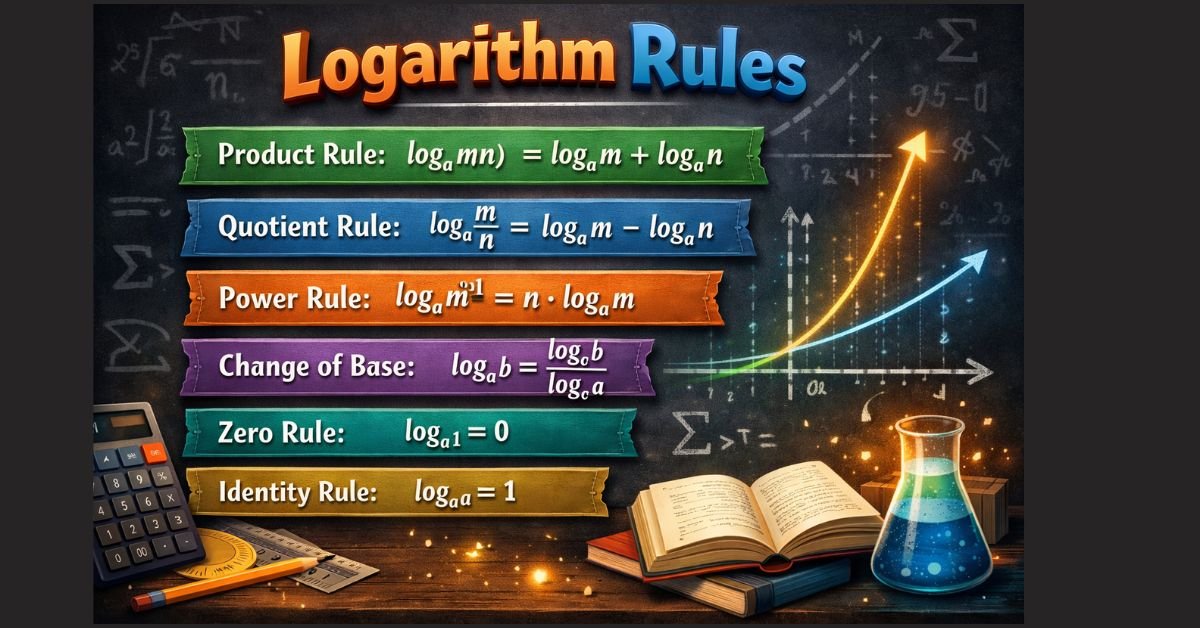
In my previous post, I introduced the concept of logarithms to you. I explained how logarithms and exponents are connected, and then showed you a quick trick to help you remember how to convert between the two. Now in this post, I’m going to go a little bit deeper and explain a few rules of logarithms to help you actually do math with them. Considering how you now already know that logs and exponents are related, it should come as no surprise that, just like there is a set of exponent rules, there is also a set of logarithmic rules.
As you look at these logarithm rules, keep in mind that by convention, if you write logs without the subscript number to indicate their base, it is assumed that you are dealing in base–10. For simplicity, this is the convention that I am going to use in this post, though these rules certainly apply when dealing with logs of other bases.
With that intro out of the way, let’s get to it.

The first law of logarithms is the product rule. If you are familiar with the product rule of exponents, then this logarithm law should be a piece of cake for you. Where the exponent rule says that when multiplying exponential expressions with the same base, you simply add the exponents, this same thing applies when multiplying logarithms of the same base. Therefore, the rule states that the logarithm of a product is equal to the sum of the logarithms.
This rule is very commonly used, and it is important to recognize that you can use it in either direction. That is, the logarithm of a product converts to a sum of logarithms, and vice versa.

The next logarithmic law is the quotient rule. Again, this law can easily be derived by applying your knowledge of the exponent quotient rule (though I will leave that for you as an exercise). However, it does appear to look different. This rule states that the logarithm of a quotient is equal to the logarithm of the numerator minus the logarithm of the denominator. Sounds like a mouthful, but the expression is probably much simpler to understand.
Again, watch for opportunities to use this relationship in either direction!

The third law of logs is the power rule. This one is surprisingly simple to remember, and again can be found by manipulating exponent and logarithm laws. Quite simply, this law says that when you have a logarithm of an exponential expression, the exponent can be “brought out” of the log and used as a coefficient for the log.

The last of the rules of logarithms that I’m going to discuss here today is called the base change rule. Recall that I stated above that all of my examples that I’ve used so far in this post use the convention of an assumed base–10. If I wanted to change my expression to utilize a different base, this rule helps us to do that. So then, if I have my log in some base of a number, and I want to express this in terms of a different base, I simply take the log in my new base of the original number and divide that by the log in my new base of the original base. Sounds wordy, but again, a picture is worth a thousand words:
Here, my original base is B, and my new base that I want to express things in is X.
That is all I have to say about the rules of logarithms in this short introduction to them. They are fairly straight forward themselves, though can be used in very complex equations. I will try to do a separate post soon outlining some examples of all of these rules, though I do think that the general forms that I’ve noted above are pretty self-explanatory.
If you are interested in learning more about logarithms, there is a much more thorough summary of logarithms at the Learning and Teaching Math blog, which I highly recommend (for this and other math topics!)
-

 TECH7 months ago
Apple iPhone 17: Official 2025 Release Date Revealed
-

 BLOG7 months ago
Understanding the ∴ Symbol in Math
-

 ENTERTAINMENT5 months ago
What Is SUV? A Family-Friendly Vehicle Explained
-

 EDUCATION7 months ago
Horizontal Translation: How to Shift Graphs
-

 EDUCATION8 months ago
Using the Quadratic Formula
-

 EDUCATION7 months ago
The Meaning of an Open Circle in Math Explained
-

 HEALTH7 months ago
GoodNever: Wellness, Simplified
-

 ENTERTAINMENT7 months ago
Going Live: How to Stream on TikTok from Your PC